
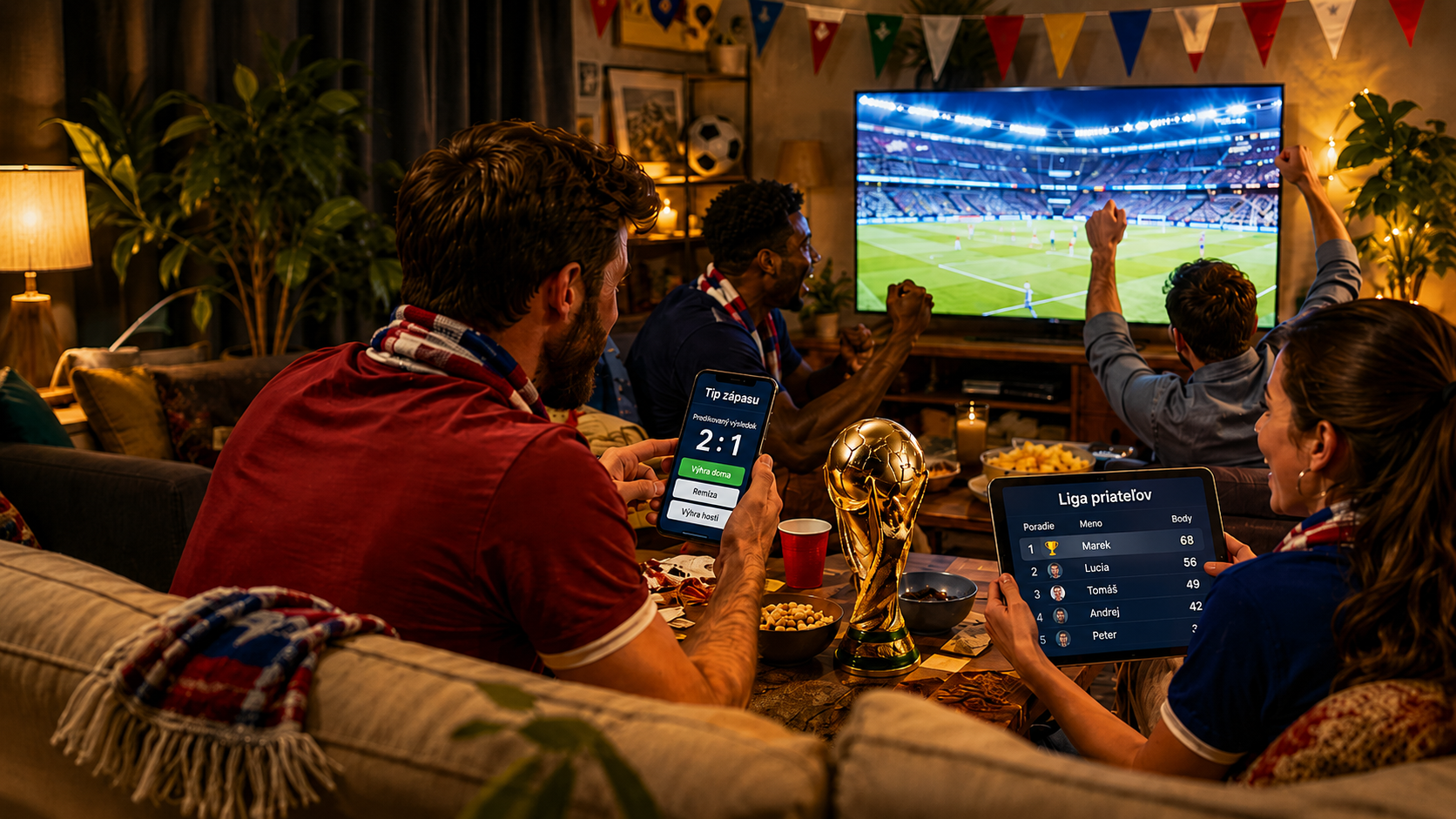
A World Cup 2026 prediction game is a free, points-based competition in which friends or colleagues predict the scores of FIFA World Cup 2026 matches and compete on a shared leaderboard — with no betting and no money wagered. Instead of staking cash with a bookmaker, everyone simply guesses results, earns points for accuracy, and climbs the table across the tournament. It is the no-betting, no-spreadsheet way to run an office sweepstake or a pool with mates.
The FIFA World Cup 2026 is the perfect excuse to start one. It runs from 11 June to 19 July 2026 and is the largest World Cup ever staged: 48 teams, 12 groups of four, and a record 104 matches — 40 more than Qatar 2022. That is more than five weeks of fixtures to predict, plenty of room for upsets, and a steady stream of talking points for any office kitchen or group chat. This guide explains exactly how a prediction game works, why it beats both spreadsheets and betting apps, and how to get your own pool live in a few minutes.
What a World Cup 2026 prediction game actually is
At its heart, a prediction game is simple. Before each match, every participant submits a predicted scoreline. Once the match finishes, the system compares predictions to the real result and awards points. The more accurate your guess, the more points you score. Over the 104 matches of the tournament, those points add up into a leaderboard, and the person on top at the end wins.
That format goes by many names — a World Cup 2026 sweepstake, a pick'em, a prediction pool, or a prediction league — but the mechanic is the same. Crucially, it is not betting. Nobody puts money on the line, there is no bookmaker, and there are no odds. It is a "tipovačka bez sázení": a purely points-based prediction game. The reward is bragging rights and whatever symbolic prize the organiser sets, not a cash payout.
This distinction matters more than it might seem. Betting houses such as Tipsport or Fortuna are built around financial risk, which excludes the colleagues who are not comfortable gambling and which can be a non-starter in many workplaces. A prediction pool sidesteps all of that. Everyone can join, the stakes are friendly, and the only thing at risk is your reputation as the office football expert.
If you want the deeper background on the tournament itself as a team activity, our companion guide on running a corporate pool for the 2026 Football World Cup walks through the organiser's side in detail.
Why the World Cup 2026 is built for a prediction pool
A few tournament facts make the 2026 edition unusually well suited to a long-running prediction game.
First, the scale. With 48 teams instead of the old 32, the group stage alone is enormous. Twelve groups of four produce a flood of fixtures in the opening fortnight, which means there is almost always a match to predict and a reason to check the leaderboard. The expanded format also introduces a new Round of 32 knockout stage, where the eight best third-placed teams advance — so even sides that stumble in their group can still progress, keeping more nations (and more of your participants' favourites) alive for longer.
Second, the geography. The tournament is hosted across three countries — the USA (11 cities), Canada (2 cities), and Mexico (3 cities). It opens on 11 June 2026 with Mexico vs South Africa in Mexico City, and ends with the final on 19 July 2026 at MetLife Stadium in the New York/New Jersey area. The North American time zones are a genuine factor for European players, which we cover below.
Third, the length. More than five weeks of football is a long stretch for any shared activity. A well-run pool turns that length into an advantage: a steady rhythm of predictions, daily leaderboard movement, and a recurring conversation that pulls in even the colleagues who never normally watch a game.
For a full breakdown of who plays whom, see our World Cup 2026 groups overview, and for how the expanded knockout maths works, the third-placed teams table explainer.
Prediction game vs sweepstake vs spreadsheet
If you have run a World Cup pool before, you have probably used one of two old methods. Both have real drawbacks.
The classic office sweepstake is the one where everyone draws a country out of a hat and wins if their team goes far. It is fun for thirty seconds, but it is pure luck — there is no skill, no ongoing involvement, and once your randomly drawn team is knocked out you have nothing left to care about. Half the office checks out after the group stage.
The shared spreadsheet is the other extreme. It does reward skill, but the organiser pays for it dearly: building the fixture grid, chasing people for missing predictions, and manually totting up points after every single one of the 104 matches. Errors creep in, disputes follow, and the admin loses hours they will never get back.
A modern prediction game keeps the skill of the spreadsheet and the inclusivity of the sweepstake while removing the admin entirely. The fixtures, scores, and points are all handled automatically. You can read how the mechanics work end to end in how it works, or compare the difference between a luck-based draw and a skill-based pool in our prediction game with friends guide.
How to set up your pool in a few minutes
Getting a World Cup 2026 prediction game live is genuinely a five-minute job. There is no software to install and no IT request to file.
You start by going to the site and choosing to sign in with Google. One click, no new password, no registration form — you reuse the Google account you already have. From there you create a new pool, give it a name your team or friends will recognise, and select the FIFA World Cup 2026 from the list of competitions. The system then loads the complete fixture list, dates, and teams automatically, and keeps results updated for you throughout the tournament.
Because the basic version is free and needs no payment card to start, there is nothing standing between you and a working pool. For most offices and friend groups it is plenty; if you need more, the details are on the pricing page.
Inviting friends or colleagues
Once the pool exists, you invite people with a single shareable link or a QR code that the system generates. Drop the link into your group chat, your Slack or Microsoft Teams channel, the company newsletter, or print the QR code and pin it to the kitchen noticeboard.
The pool is private. Predictions, scores, and the standings are visible only to the people you grant access to — there is no public view into your group. And because joining means one Google click rather than filling in a form, the drop-off you normally get with "sign up for this thing" is far smaller. People tap the link, log in, and they are in.
There is also nothing to download. trefa.app is a PWA (Progressive Web App), so participants open the link in their phone browser and add it to the home screen in about five seconds. From then on it behaves like a native app — it sits on the home screen and runs smoothly — but it never goes through an app store and never needs sign-off from a corporate security policy.
Scoring you control
The admin sets the scoring rules, and keeping them clear is the single biggest driver of engagement. A common and easy-to-grasp model rewards accuracy in tiers:
- Exact score earns the most points. Predict 2–0, the match ends 2–0, and you take the maximum.
- Correct winner and goal difference earns a middle amount. You got the margin and the right side, just not the precise scoreline.
- Correct winner earns a base score, even if the scoreline was off.
On top of the per-match scoring, you can add bonus questions that run for the whole tournament — who will win the World Cup, who will be top scorer, and similar long-range calls. These keep the pool interesting even for participants who fall behind on individual matches, because one good tournament-winner pick can swing the final standings.
You can adjust all of this to suit your group, including how draws are handled in the group stage. The full menu of options lives in features, and a step-by-step on tailoring the points is in our custom scoring rules guide.
The night-match problem (and the sleep-mode fix)
Here is the practical catch for anyone running a World Cup 2026 prediction game outside North America: a lot of these matches kick off in the middle of the European night. With venues spread across the USA, Canada, and Mexico, plenty of fixtures land at hours when most of your participants are asleep.
The traditional fear is that a 3 a.m. kickoff means missed predictions and a dead leaderboard the next morning. A good prediction app solves this with what amounts to a sleep mode: you submit your tips for upcoming night matches in advance, whenever it suits you, and the app evaluates them automatically once each match ends. You go to bed having locked in your guesses, and you wake up to an already-updated leaderboard.
To make sure nobody forgets, the app also sends push notifications before kickoff, nudging anyone who has not yet entered their numbers for a match. Combined with advance submission, that means the night schedule stops being a problem and becomes a non-issue — your pool keeps moving while everyone sleeps.
Keeping the pool alive across five weeks
Launching the game is only the start. The tournament runs for more than five weeks, so a little ongoing communication keeps it from going quiet.
The real-time leaderboard does a lot of the work for you: it updates right after each match ends, so there is always fresh movement to talk about. Lean into that. After a big upset, post the new standings in your channel and call out who climbed and who tumbled. The automated push notifications handle the reminders, and the morning after a busy night of fixtures is the perfect moment to share a quick "here's where we stand" message.
Set a symbolic prize and remind people what is at stake. It rarely needs to be expensive — a team lunch, a travelling trophy on the winner's desk, or the right to choose the office coffee for a month tends to motivate far better than electronics. The point is the shared experience, and the prediction game gives you 104 matches' worth of it.
FAQ
What is a World Cup 2026 prediction game? Answer: It is a points-based competition where you predict the scores of FIFA World Cup 2026 matches against your friends or colleagues. There is no money wagered — players earn points for accurate predictions and climb a shared leaderboard across all 104 matches.
Is the World Cup 2026 prediction game free? Answer: Yes. On trefa.app the basic version is free, and you do not need a payment card to start. You create a pool, invite people, and play.
Is this betting or gambling? Answer: No. A prediction game is not betting — no stakes, no money, no bookmaker. It is a "tipovačka bez sázení", a purely points-based prediction pool. That is the main difference from betting houses like Tipsport or Fortuna.
How do players join the prediction pool? Answer: You share a single invite link or a QR code. Players log in with one click using their Google account — no passwords, no sign-up forms. The whole join takes a few seconds.
Do we have to install an app? Answer: No app store download is needed. trefa.app is a PWA (Progressive Web App): players open the link in a browser and add it to their home screen in about five seconds. It then behaves like a native app.
How does scoring work? Answer: The admin sets the rules. A common model awards the most points for the exact score, fewer for the correct winner and goal difference, and a base score for the correct winner. You can also add bonus questions such as the tournament winner or top scorer.
Many matches are at night in Europe — how do we predict those? Answer: You can submit your tips for night matches in advance. The app evaluates them automatically once the match ends, so you wake up to an updated leaderboard. No need to stay up for a 3 a.m. kickoff.
When does the World Cup 2026 start and finish? Answer: FIFA World Cup 2026 runs from 11 June to 19 July 2026. The opening match is Mexico vs South Africa in Mexico City, and the final is on 19 July at MetLife Stadium near New York.
Start your free prediction game
You do not need a budget, a spreadsheet, or a bookmaker account to enjoy the World Cup 2026 prediction game with your friends or colleagues. It takes about five minutes to create a pool, share the link, and get everyone predicting — with no betting and no money involved, just points, a live leaderboard, and 104 matches of friendly rivalry. If you are ready to turn the biggest World Cup ever into a shared summer, head over and create your free pool and start playing.