
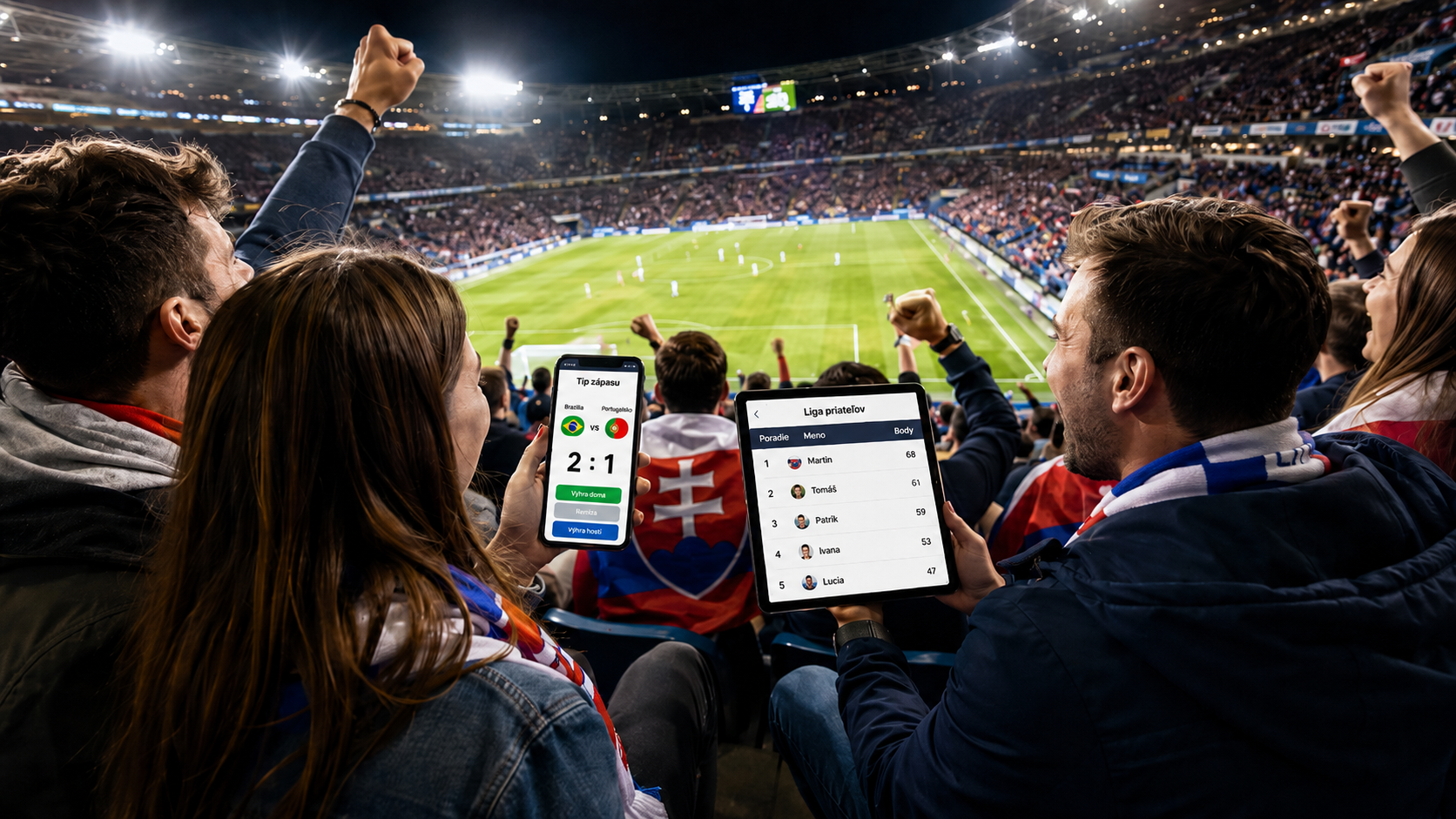
June and July are the months when, in many offices, the usual morning chat at the coffee machine drifts naturally from work projects to football. The World Cup is an ideal opportunity to connect colleagues across departments. Watching results together and a bit of friendly rivalry can enliven corporate culture far more effectively than forced team-building activities. If you are looking for a way to harness that potential, a corporate betting pool for the 2026 Football World Cup is exactly the format that makes sense.
Organising something like this in a work environment does take some preparation. In the past, it meant hours spent fiddling with complicated spreadsheets, constantly chasing colleagues for missing predictions and manually calculating points after every match. Today, the whole process is much simpler. Setting up and running a league can be done in a few minutes, without the organiser having to sacrifice their valuable working time.
This guide will walk you through the whole process in detail. You will learn how to set up the competition technically, how to involve the right number of people and how to keep participants engaged throughout the long tournament. You will also find out more about how it works with modern tools that do not require installing complicated software and are designed specifically for the needs of teams at work.
Why the 2026 Football World Cup
The Football World Cup is a global social phenomenon, and the 2026 tournament will be exceptional in many ways. Hosted jointly by the USA, Canada, and Mexico across 16 different cities, the opening match will take place at the famous Estadio Azteca in Mexico City, and the final at MetLife Stadium in New York/New Jersey.
It will be the largest tournament in history. The number of participants has expanded to 48 teams divided into 12 groups of four. This means a total of 104 matches and huge room for surprises from theoretically weaker teams. For Czech fans, this edition carries enormous excitement. The national team returns to the World Cup after 20 long years, and in Group A they will face South Korea, South Africa, and the host nation, Mexico.
From the perspective of a corporate activity, the key factor is the length of the tournament. It runs for a full 39 days, from 11 June to 19 July. It is therefore not just a quick two-week event, but a long-term activity that will give the company a regular rhythm and a topic of conversation for more than a month. A well-organised betting pool will pull in even those colleagues who do not normally follow sport. The atmosphere of a major tournament and the simplicity of guessing results combine to blur the line between die-hard fans and complete novices.
What you need before starting
Before you send out the first invitations, it is worth thinking the whole event through carefully. Good preparation will save you a lot of questions later in the summer. An ideal company betting competition requires clear rules and a person who takes on the organisation.
Here is the basic checklist of what you should have ready:
- A main organiser: Designate one person who will set up the league and act as the point of contact. Most often this role falls to an HR manager, an office coordinator or simply someone who enjoys bringing people together.
- Estimated number of participants: Be clear about who you want to invite. Whether it is a small team of ten, a whole department, or the entire company.
- A communication channel: Decide where you will communicate about the league. It can be a dedicated channel on platforms such as Slack or Microsoft Teams, or a regular group email. Given the length of the tournament (39 days), a steady and regular communication rhythm is absolutely essential.
- Schedule: Set a clear deadline by which people must sign up to the league. Ideally, close registration the day before the opening kick-off on 11 June.
- Rewards for the winners: Think about what is at stake. There is no need to come up with expensive prizes; symbolic rewards with a social touch often work best.
If you have these points sorted, you can move on to the technical solution itself. More information about the trefa.app app and its benefits for corporate culture will help you understand why choosing the right tool matters.
Step 1 — Build your league in 5 minutes
The biggest obstacle when organising activities like this is usually the administrative burden. The traditional approach involved creating a shared spreadsheet, sending out a link and then manually checking it. This method is prone to errors and creates unnecessary stress for the organiser.
A modern alternative to Excel for predictions automates the whole process. Creating a league requires no technical knowledge and no complicated setup by the IT department.
The procedure is straightforward. As the organiser, you go to the platform's website and choose the option to sign in with Google. This step is crucial for user convenience. Participants do not need to remember additional passwords or create new accounts — they simply use their existing work or personal Google account.
Once signed in, you create a new league. You give it a name that clearly identifies your team or company. Then you select "2026 Football World Cup" from the list of supported competitions. The system automatically loads the complete fixture list, dates and teams. From this point on, the platform takes care of running results updates.
There is, however, one specific aspect of national-team tournaments. Coaches close their 26-man squads only just before the start of the championship. If you want to predict individual goalscorers with your colleagues, the administrator will need to upload these squads to the system manually before the tournament kicks off.
If you would like to bet on other competitions or need advice on setup, simply write to our Facebook page.
Step 2 — Invite your colleagues
Once the virtual space is ready, it is time to distribute the invitations. A community betting league is meant to be a safe and closed environment. Results, predictions and the current standings are visible only to the people you grant access to. No one from outside has a view into your company group.
The invitation works via a unique link or QR code that the system generates. You can easily paste this link into the company newsletter, pin it to the header of your Slack channel, or print it and put it on the noticeboard in the kitchen.
When communicating with colleagues, make sure you emphasise the casual and friendly nature of the whole event. Explain that taking part does not require a deep knowledge of football tactics and that the system is as intuitive as possible.
For many people, it is important to know that they do not have to install any application from the App Store or Google Play. The system works as a so-called PWA (Progressive Web App). This means that users open the link in the browser on their mobile phone and, with one click, add the icon directly to their home screen. The application then behaves like a native one, runs smoothly in the background, but does not take up phone memory and does not require complex approval from corporate security policies.
Step 3 — Set up scoring that makes sense
The administrator's key task is to set the rules for awarding points. A simple principle applies here: the clearer the system you choose, the more people will stay motivated to compete to the very end. Overly complex mathematical models can put participants off.
In the features section you will find options for adapting the scoring. A three-tiered model for evaluating a single match is commonly used:
Exact result
The highest number of points goes to a participant who guesses the exact score of the match. For example, if they predict 2:0 and the match actually ends 2:0, they get the maximum number of points.
Goal difference
The middle value is awarded to anyone who does not guess the exact number of goals but correctly predicts the winner and the exact goal difference. For example, a participant predicts 3:1 (a two-goal margin for the home side). The match ends 2:0. The participant correctly identified both the winner and the goal difference, and therefore receives partial points.
Correct winner
The base score is awarded to anyone who correctly determines which team will take points from the match, regardless of the exact result.
Football specifics and draws
Unlike in some other sports, in football — especially in the group stage — draws are very common. People tend to predict them less often, however, because they naturally root for one of the teams. It therefore makes a lot of sense to enable a bonus point for a correctly predicted draw. This small detail can shake up the standings in an interesting way.
Also remind colleagues that in the knockout stage the prediction is for the result after regulation time (90 minutes). Any extra time or penalty shoot-outs do not count towards the basic prediction, which is the standard approach that keeps the scoring fair.
For a detailed guide on setting custom scoring rules for the World Cup, see Football World Cup 2026 Prediction Pool — Custom Scoring Rules.
Step 4 — Keep it lively during the tournament
Launching the league is only the first step to success. The tournament runs for 39 days, which is a fairly long period from a corporate communication perspective. For the activity to fulfil its purpose and support corporate culture, you have to keep participants engaged throughout. This is where the advantages of an automated solution come into their own.
One of the biggest risks is that people simply forget to send in their predictions. Thanks to PWA technology, the application can send push notifications directly to the phone's lock screen. Participants get a gentle reminder before the start of matches for which they have not yet filled in their numbers. Another popular feature is the automatic morning emails that summarise the previous day's results and show who went up and who went down in the table.
The group stage, which runs from 11 to 27 June, offers around 72 matches. It is an intense period when the standings change every day. Once it is over, a short break follows and the tournament moves into the knockout phase, into which 32 teams progress. These are ideal moments for communication on the company intranet. Publish the current standings, comment on the biggest surprises of the tournament and remind everyone what is at stake.
As the competition enters the play-off, the dynamics change. There are fewer matches, but the tension rises. The rewards for the winners should support team spirit. Instead of expensive electronics, prizes such as a shared lunch on the company, a travelling trophy on the desk, or the privilege of choosing the office coffee for the next month work much better.
Common mistakes (and how to avoid them)
Despite the simplicity of the whole process, there are situations in practice that can spoil the overall impression. Here is an overview of the most common pitfalls and how to avoid them.
- A late start: If you send out the invitations on the day the tournament starts, many people will read the message too late. Ideally, start communicating at least a week before the first match.
- Overly complicated rules: Attempts to introduce additional coefficients or multipliers lead to confusion. People want to open the app, type in two numbers and watch the result. Stick to the basic scoring setup.
- Lack of ongoing communication: The tournament lasts more than a month. If people stop talking about the league after launch, it becomes just a silent app on the phone.
- Forgetting colleagues outside the office: June and July are the months of summer holidays. People are away from the office much more often than in the spring. Make sure the invitation reaches all digital channels. The advantage of the app is that colleagues can comfortably submit their predictions even from the beach.
- Unclear reward: Even though people compete primarily for fun, the absence of any reward, however symbolic, takes away from the competition's appeal at the very end.
Common questions
When introducing a new tool into a company, questions naturally arise from management and employees alike. Below you will find answers to the most common ones. A full overview is available in the frequently asked questions section.
How much will it cost the company? For smaller and medium-sized teams, the basic version of the application is free of charge. You will find the details on the pricing page. If your company needs a specific tailored solution or wants to involve a large number of departments, conditions are set on an individual basis.
Do employees have to install an app on their phone? No. The system does not require the installation of a classic app from the stores. It works through a web browser with the option of adding a shortcut to the phone's home screen (PWA), which bypasses the need for complex approval by the corporate IT department.
Is the company data safe? Yes. The league cannot be found publicly. Access is granted only to people who have the unique link from the administrator. Login takes place securely through Google's infrastructure.
Can we continue with another sport after the World Cup? The platform supports a range of other competitions. With the arrival of autumn, you can seamlessly move on to, for example, the football Premier League, the NHL or the Czech Extraliga.
Start for free
Organising a shared activity around the upcoming World Cup does not require complex planning or a budget. All it takes is five minutes of your time to set up a league and send invitations to your colleagues. You will create a space for shared experiences that will naturally strengthen relationships at work throughout the summer. If you are ready to bring some football atmosphere to your office, simply head to the main page and try it for free by creating your first league.